This exercise involved a serial exploration of the base geometry used in the Recursive Folding process (see previous entry). Rather than utilizing a lo-res base geometry to build spatial complexity, this exploration used a lo-res base geometry and worked backwards to strategically unfold the complex spatial-form into a developable plane. The purpose of the new trajectory is to understand how a project state can be assumed and then used to reverse engineer the process into a more tangible starting point. These simplified forms also contain the a greater potiental to be aggregated into a single larger structure that would be defined by its enclosure (as opposed to its mass).The first step involved generating (25) 5-sided triangulated shapes. The surfaces all share corner points and edges with adjacent surfaces. These 25 possibilities were analyzed to determine if any planes intersected one another (which many did). Five forms were chosen to be studied through the reverse-morphometric process.click image for larger view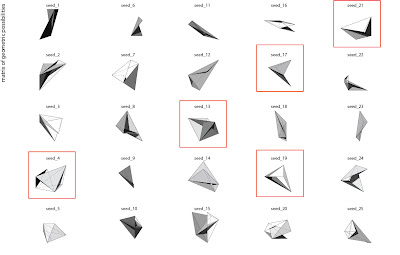 The chosen forms each went through a 4 step iterative process. At each step there were several options for the form: rotation of a surface about an adjacent edge, re-triangulation of a surface based on corner points of other surfaces, and deletion of non-confoming surfaces.click image for larger view

This study is an attempt to capture the spatial aspirations embedded in an earlier physical construct/model by translanting the intrinsic rules of the physical model into grasshopper operations. Rather than attempting to build the digital model in a single grasshopper sequence, I decided to establish a recursive process in which every step was baked into rhino and used to determine the outcome of the next step. The operation started by randomly selecting 4 points from an square XY grid that has been jittered in the Z direction. These 4 points are then connected to form 2 (or 3) triangular surfaces adjoined along a single side. These surfaces are then rotated along the other surfaces' centroid by an angle equilivent to the original fold. (This probably sounds more complex than it really is - essentially each new surface is created based on the values of the original surface).After this operation (Series_1 below) the surfaces began to add together through a recursive process. The recursive process involves step 'A' being baked into rhino and brought back into grasshopper as a rotation about the surfaces in step 'B'. This process continues through step 'E'. Since the series is not completely automated (which would have required a VBscript) it allowed an opportunity to control some of the parameters like surface selection and line of rotation. Any non-contiguous surfaces were eleminated in each step.For a clear example of the recursive effect compare series_1 and series_3 (below).click image for larger view.


